Air Fryer vs Convection Oven: Pros, Cons, and Which to Pick
For fast, crisp meals in small batches, an air fryer vs convection oven comparison usually favors the air fryer. For larger pans, baking, and cooking several servings at once, a convection oven is the better fit. Both use a fan to move hot air, but an air fryer has a smaller cooking chamber and stronger airflow around the food.
The best choice depends less on which appliance is “better” and more on what you cook, how many people you feed, and how much counter space you have.
Key Takeaways - Choose an air fryer for quick cooking, crisp snacks, and meals for one to three people. - Choose a convection oven for sheet-pan dinners, baking, casseroles, and family-size portions. - A full-size convection oven needs more time to heat, but it handles far more food. - Both appliances need space around food. Overcrowding reduces browning and crispness. - A countertop convection oven with an air-fry setting can be a useful middle ground, but it is not identical to a basket air fryer.
Air fryer vs convection oven at a glance
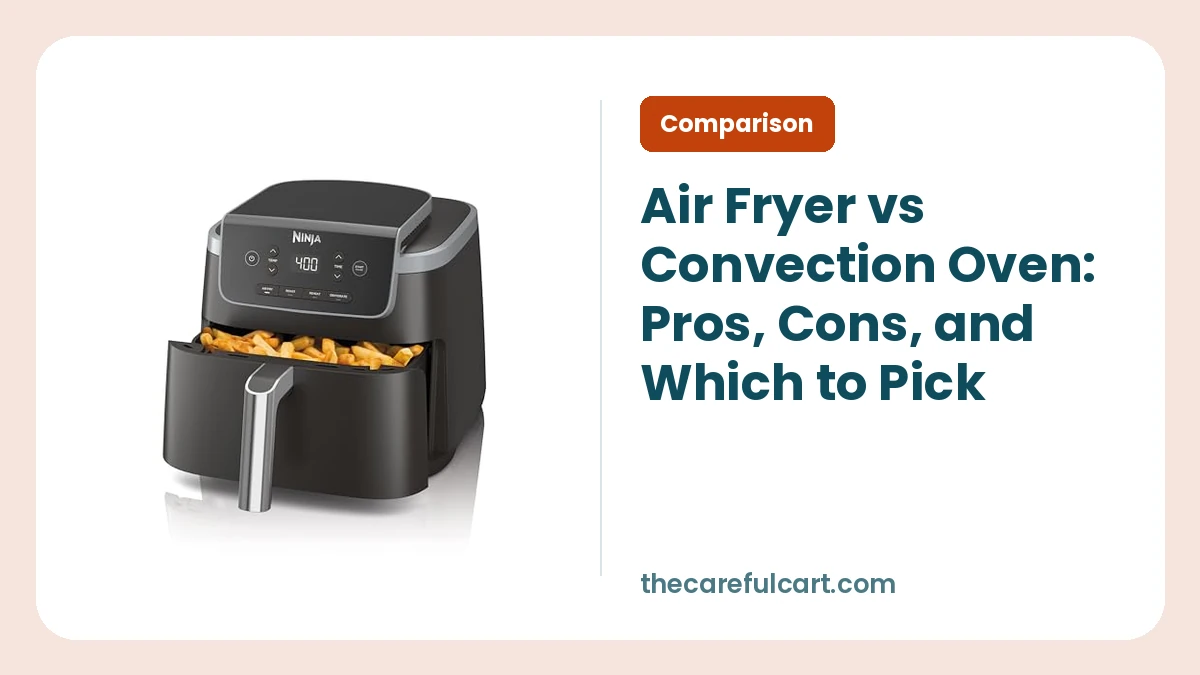
An air fryer is a compact countertop appliance with a heating element and powerful fan near the top. Food sits in a perforated basket or tray, so hot air reaches more of its surface. That circulation browns and crisps food with little added oil.
A convection oven is an oven with a fan that circulates hot air during cooking. It may be a full-size built-in or freestanding oven, or a countertop toaster oven. Its larger cavity holds baking pans, casserole dishes, and multiple racks.
| Feature | Basket air fryer | Full-size convection oven |
|---|---|---|
| Best for | Small, quick, crisp foods | Large meals and baking |
| Capacity | Usually one to four servings | Several servings or multiple dishes |
| Preheating | Short or sometimes unnecessary | Longer, especially for baking |
| Airflow | Intense and close to food | Gentler across a larger cavity |
| Crisping | Excellent for fries, wings, and vegetables | Good, especially with a rack or dark pan |
| Cookware | Basket, rack, small oven-safe accessories | Standard sheet pans, dishes, Dutch ovens |
| Counter space | Requires permanent or stored counter space | Full-size units use no counter space |
| Cleanup | Basket and crisper plate need washing | Pans, racks, and oven interior need cleaning |
How each appliance cooks food
Both appliances cook with convection, which means moving hot air transfers heat faster than still air. The difference is the size of the chamber and the force of the airflow.
Why an air fryer crisps so well
The small chamber lets hot air circulate tightly around food. The perforated basket exposes the bottom and sides, rather than trapping moisture against a solid pan. Surface moisture evaporates faster, which helps browning happen.
This design works especially well for breaded foods, frozen fries, chicken wings, Brussels sprouts, and reheated pizza. A light coating of oil improves color and texture, but you do not need to submerge food in oil.
Do not confuse “air fried” with deep fried. An air fryer can produce a crisp exterior, but foods without breading, natural fat, or a small amount of oil will not taste exactly like deep-fried food.
How a convection oven handles more kinds of cooking
A convection oven spreads heat around a much larger space. The fan reduces hot and cool spots and can speed roasting. It also helps dry the outside of foods such as chicken skin and roasted potatoes.
The larger oven cavity gives you flexibility that a basket cannot. You can bake cookies, roast a whole chicken, make a lasagna, or cook vegetables on one rack while another dish warms. For delicate cakes, custards, soufflés, and some quick breads, conventional bake mode may be better because strong moving air can dry or tilt delicate batter.
Air fryer vs convection oven pros and cons for everyday meals
The practical air fryer vs convection oven pros and cons become clear once you picture a normal week of meals.
Air fryer benefits
An air fryer saves time on small jobs. It heats a compact space quickly, and its basket makes turning food simple. Many foods cook well with less oil than pan-frying or deep-frying.
Its main advantages include:
- Fast cooking for frozen snacks, vegetables, and proteins.
- Strong browning and crisping from all-around airflow.
- Less heat released into your kitchen than a large oven.
- A removable basket that contains crumbs and grease.
- Simple portions for lunches, side dishes, and leftovers.
Its limits matter too. The basket can crowd quickly, and wet batter drips through the holes before it sets. Large roasts, wide pizzas, tall casseroles, and a dozen cookies are poor fits. Cooking in several batches can erase the time saved by fast preheating.
Convection oven benefits
A convection oven gives you room and versatility. It can cook a complete meal, hold familiar cookware, and replace conventional baking for many recipes.
The main convection oven benefits include:
- Large capacity for families, guests, and meal prep.
- Space for sheet pans, cake pans, roasting pans, and covered dishes.
- Better results than a conventional oven for many roasted foods.
- The ability to cook multiple components at once.
- No additional countertop appliance with a full-size oven.
The trade-off is heat-up time and energy used for small portions. Heating a full oven for a handful of nuggets or a small bowl of vegetables is inefficient. A convection oven also does not surround food as closely as an air-fryer basket, so it may not create the same deep crispness without turning food or using a wire rack.
Which is better, an air fryer or convection oven for common foods?
Which is better, an air fryer or convection oven depends on the food and the batch size. The air fryer wins for foods that benefit from direct airflow. The convection oven wins when shape, volume, or cookware matters.
Foods that favor an air fryer
Use an air fryer for small portions of food that need a crunchy surface:
- Frozen fries, tater tots, and breaded shrimp
- Wings, drumsticks, and small chicken thighs
- Salmon fillets and pork chops
- Broccoli, cauliflower, zucchini, and cubed potatoes
- Reheated fried food and pizza slices
- Toasted sandwiches or small quesadillas
Leave room between pieces. A single layer gives the best result. Shake the basket or turn larger pieces halfway through cooking. For foods coated in a sugary sauce, cook the food first and brush on the sauce near the end so it does not burn.
Foods that favor a convection oven
Use the convection oven for larger portions and foods that need a solid pan or dish:
- Sheet-pan chicken and vegetables
- Cookies, biscuits, and pies
- Baked pasta, casseroles, and gratins
- A whole roast chicken or large roast
- Large pizzas and several baked potatoes
- Multiple trays of food for a group
For crisp oven food, use a rimmed baking sheet and avoid lining it with a solid sheet of foil. Parchment paper is useful for easy cleanup, but it slightly reduces airflow underneath. A wire rack set inside a sheet pan lets air reach more of the food.
Speed, capacity, and kitchen space
For one or two servings, the air fryer is usually faster from start to finish. Many models need only a few minutes of preheating, and some recipes can start in a cold basket. Check food early because compact appliances can brown faster than expected.
A convection oven needs more time to preheat. Once hot, it becomes the better tool for a full dinner. One sheet pan of chicken, vegetables, and potatoes is easier than running three air-fryer batches.
Measure your available space before buying either countertop option. An air fryer needs clear space around its air vents, plus enough room to pull the basket straight out. Do not place it under a low cabinet while it is running, and do not set it close to a wall.
A countertop convection oven needs more clearance because its exterior and door become hot. Its door swings forward, so it needs open counter space in front. Confirm the manufacturer’s clearance instructions instead of guessing.
Ease of use and cleanup
A basket air fryer is easy to load, shake, and wash after simple foods. Most have a removable crisper plate that lifts out of the basket. Wash both parts after greasy cooking. Leaving oil and crumbs in the bottom can cause smoke and old-food odors during the next use.
Avoid metal utensils on nonstick baskets. Soak baked-on residue in warm, soapy water, then use a soft sponge. Check your manual before putting parts in the dishwasher, even if the coating appears durable.
A convection oven has more parts to manage: pans, racks, and sometimes a crumb tray. Still, cleanup can be easier after a large meal because all the food cooks in one or two pans instead of repeated batches. Wipe splatters once the oven has cooled, before grease bakes on.
Never line an air-fryer basket or oven floor in a way that blocks vents or airflow. Loose parchment can lift into the heating element. Use perforated liners designed for the basket, or weigh parchment down fully with food.
Safety and energy use
Both appliances have exposed hot surfaces and need attentive use. Place them on a stable, heat-resistant surface. Keep paper towels, plastic containers, and dish towels away from the heating area. Let the appliance cool before cleaning.
Air fryers can smoke when fat drips onto hot surfaces. Trim excess fat from very fatty cuts, empty old grease, and add a small amount of water beneath the basket only if your manufacturer allows it. Never pour water onto hot oil or a hot heating element.
Use oven mitts for hot trays, racks, and baskets. The basket handle can be safer than a bare rack, but the inner crisper plate and sides stay very hot. Keep children away from both appliances while cooking, and follow the manual for electrical and ventilation requirements.
For energy use, smaller cooking chambers use less energy for small portions because they heat less air and run for less time. A convection oven makes more sense for larger quantities because it avoids repeating several air-fryer cycles. The most efficient appliance is the one that cooks your meal in one round.
Choose an air fryer or convection oven based on your routine
Choose an air fryer if you:
- Cook for one to three people most nights.
- Want crispy frozen foods without heating the whole oven.
- Reheat leftovers and make quick vegetable sides.
- Have counter space and do not mind washing a basket.
- Prefer fast, hands-on cooking with shaking or turning.
Choose a convection oven if you:
- Feed a family or cook several portions at once.
- Bake frequently or use casserole dishes and standard pans.
- Make sheet-pan meals, large proteins, or holiday dishes.
- Want one appliance that handles roasting, baking, and broiling.
- Have a full-size convection oven already and only need occasional crisping.
A countertop convection oven with an air-fry mode suits kitchens that need more pan space than a basket provides. Read the interior dimensions before choosing one. The label “air fry” does not guarantee it can crisp a crowded tray as quickly as a compact basket model.
Make the choice easier before you buy
Write down three meals you cook most weeks, then match the appliance to those meals. A person who makes frozen appetizers, salmon, and roasted vegetables will get frequent use from an air fryer. Someone who makes cookies, tray bakes, and family dinners will gain more from convection capacity.
Also check the electrical setup. High-watt countertop appliances should plug directly into a properly rated wall outlet, not an overloaded power strip. Read the manual before first use, wash removable parts, and run any recommended first-use heating cycle to clear manufacturing residues.
The real air fryer vs convection oven decision is simple: choose focused speed and crispness for small meals, or choose flexible capacity for bigger cooking jobs.
Frequently Asked Questions
Is an air fryer just a small convection oven?
An air fryer uses convection, but it is more than a small oven in practice. Its compact chamber and perforated basket place food close to strong circulating air. That setup cooks small foods quickly and creates more surface crispness than many full-size convection ovens.
Can you use an air fryer instead of a convection oven?
You can replace a convection oven for many small meals, sides, and reheated foods. You cannot replace it for large sheet pans, casseroles, baking projects, or meals for several people. Basket size and the lack of standard cookware space are the biggest limits.
Do air fryers use less electricity than convection ovens?
For a small serving, an air fryer generally uses less electricity because it heats less air and cooks quickly. For a large meal, a convection oven can be the smarter choice because it cooks everything at once. Avoid comparing wattage alone without considering cook time and batch size.
Should you reduce temperature in a convection oven?
Many recipes need a lower temperature or shorter cooking time with convection because moving air speeds heat transfer. A common starting point is reducing the recipe temperature by 25°F, then checking food early. Follow the oven manual and use visual doneness cues.
Can you put aluminum foil in an air fryer?
You can use foil in many air fryers, but it must not block airflow or touch the heating element. Keep it weighed down by food and leave openings around the edges. Check the appliance manual first, since basket designs and manufacturer instructions differ.
Why is my food not crispy in the air fryer?
Crowding is the most common reason food stays soft. Arrange food in a loose layer, dry wet ingredients well, and shake or turn pieces during cooking. A light coating of oil also helps browning. Very wet batter needs a different method because it can drip through the basket.